





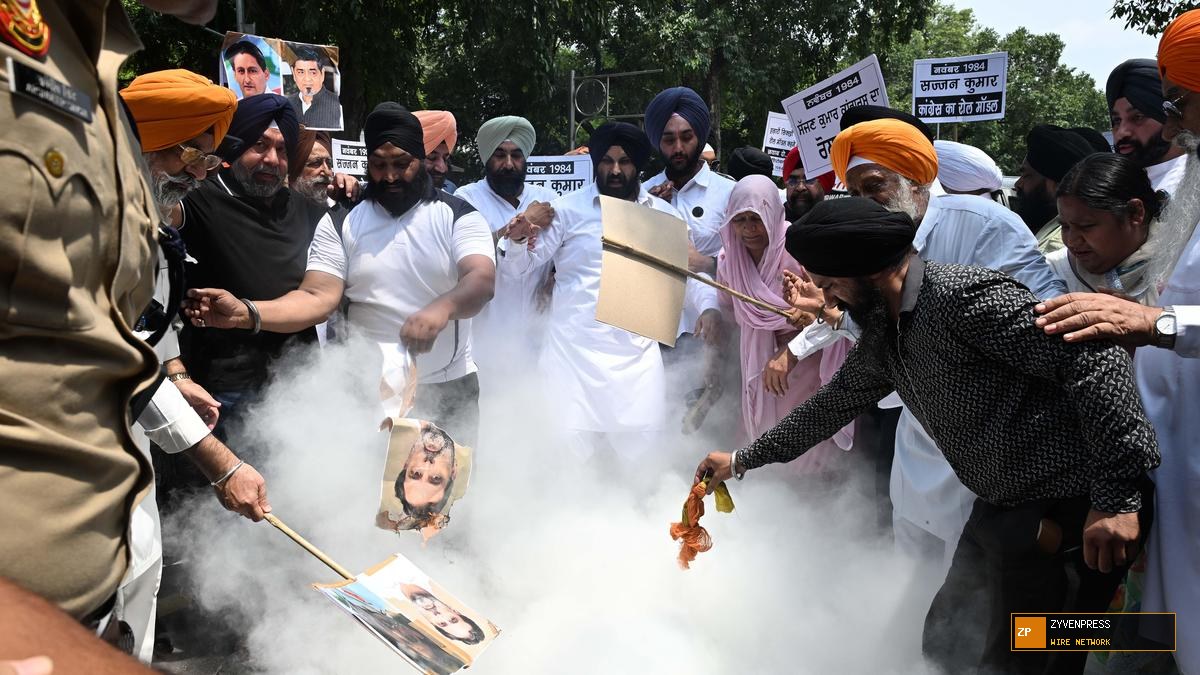

On Saturday afternoon, a crowd of more than two hundred Sikh community members and relatives of the 1984 anti‑Sikh riot victims converged on the lane outside the New Delhi residence of senior Congress figure Rahul Gandhi. The gathering, organized without official permission, culminated in the burning of an effigy of the politician, which demonstrators repeatedly struck with shoes to underscore their anger.
Trigger: a “role model” remark
The protest was ignited by comments made two days earlier by Lok Sabha MP Deepender Singh Hooda, who referred to the late Sajjan Kumar—a former Congress MP convicted for orchestrating violence during the 1984 pogrom—as a “party role model.” Kumar, who died on August 20 after a prolonged illness, had spent nearly eight years behind bars following a life‑sentence handed down by the Delhi High Court in 2018. For families still seeking justice, the description was perceived as a gross mischaracterisation of a man linked to the massacre of thousands of Sikhs.
“When a man who served time for inciting the 1984 carnage is elevated as a model, it wounds the survivors deeply,” said Harmeet Singh Kalka, president of the Delhi Sikh Gurudwara Management Committee.
Kalka, who led the demonstration, demanded a public apology from Rahul Gandhi and called for the resignation of Hooda, arguing that the Congress leadership had effectively insulted the grieving families.
Police response and detentions
New Delhi’s Deputy Commissioner of Police, Sachin Sharma, described the assembly as illegal and warned participants to disperse. When a segment of the crowd crossed police‑set barricades, officers detained five to six organizers and escorted them to the Mandi Marg police station. The detainees, including Kalka, were later released on bail, with authorities indicating that a formal case had been registered.
Historical backdrop
The 1984 anti‑Sikh riots erupted in the wake of Prime Minister Indira Gandhi’s assassination, resulting in the deaths of an estimated 3,000 Sikhs across Delhi and other parts of northern India. Over the decades, successive governments have struggled to deliver comprehensive accountability, and the issue remains a potent source of political mobilisation for Sikh groups. The conviction of Sajjan Kumar in 2018 was hailed as a rare judicial victory, though many of the accused have evaded punishment.
Political reverberations
The incident arrives at a delicate moment for the Congress party, which is attempting to rebuild its base ahead of the upcoming state elections. Critics argue that the party’s internal narrative, which occasionally attempts to rehabilitate figures linked to past violence, risks alienating minority voters. Analysts suggest that the protest could force the party to re‑evaluate its messaging, especially in regions with sizable Sikh populations.
Opposition parties have seized on the controversy, framing it as evidence of the Congress’s insensitivity. Meanwhile, Sikh leaders have warned that any further perceived glorification of 1984 perpetrators could trigger more public demonstrations, potentially disrupting law and order in the capital.
Looking forward
Legal experts note that the case against the protest organizers may set a precedent for how unauthorized gatherings are handled in politically charged contexts. Human‑rights observers, however, caution that heavy‑handed policing could exacerbate tensions, urging authorities to balance security with the right to peaceful protest.
For the families of 1984 victims, the episode underscores a lingering sense that justice remains incomplete. As the Congress grapples with internal dissent and external criticism, the Sikh community’s demand for a sincere apology and accountability is likely to stay on the political agenda in the weeks ahead.
Whether Rahul Gandhi will issue a formal apology or the party will distance itself from Hooda’s remarks remains to be seen. What is clear, however, is that the memory of 1984 continues to shape contemporary Indian politics, reminding leaders that historical wounds can quickly become flashpoints when revived in public discourse.
The incident revives the unresolved trauma of the 1984 anti‑Sikh pogroms and tests the Congress party’s sensitivity to minority grievances. It also highlights how political rhetoric can inflame long‑standing communal wounds, potentially reshaping electoral calculations in Delhi and beyond.
Frequently Asked Questions
SCHEMA INDEXED
Who was Sajjan Kumar and why is his mention controversial?+
Sajjan Kumar, a former Congress MP, was convicted in 2018 for his role in the 1984 anti‑Sikh riots that left thousands dead; praising him is seen as an affront to victims’ families.
What legal actions followed the protest?+
Police cited the demonstration as unauthorized, detained five to six leaders—including the Sikh Gurudwara committee head—and filed a case against them, though they were later released.
{“@context”:”https://schema.org”,”@type”:”FAQPage”,”mainEntity”:[{“@type”:”Question”,”name”:”Who was Sajjan Kumar and why is his mention controversial?”,”acceptedAnswer”:{“@type”:”Answer”,”text”:”Sajjan Kumar, a former Congress MP, was convicted in 2018 for his role in the 1984 anti‑Sikh riots that left thousands dead; praising him is seen as an affront to victims’ families.”}},{“@type”:”Question”,”name”:”What legal actions followed the protest?”,”acceptedAnswer”:{“@type”:”Answer”,”text”:”Police cited the demonstration as unauthorized, detained five to six leaders—including the Sikh Gurudwara committee head—and filed a case against them, though they were later released.”}}]}
